AI FORMAT

How Search Engines and AI Systems Discover and Understand Content

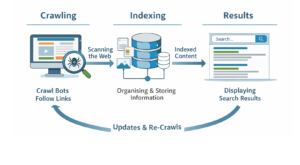
Before a web page can appear in search results, be summarised by an AI overview, or referenced in a recommendation, it has to be found and understood.
That may sound obvious, but it is where many businesses quietly lose visibility.
As search evolves from lists of blue links into AI-powered summaries and comparisons, the way content is crawled, indexed, and interpreted has become more important than ever. Content that is unclear, fragmented, or poorly structured may still exist online, but it is far less likely to be accurately represented.
This is why understanding how search engines crawl and index websites is no longer just a technical SEO topic. It is a foundational visibility issue in an AI-driven search environment.
Why crawling and indexing still matter
Search engines and AI systems do not start by ranking businesses.
They start by asking a much simpler set of questions:
Can we find this page?
Can we understand what it is about?
Can we trust it enough to reuse or summarise?
If the answer to any of those questions is unclear, your content may never reach its intended audience, regardless of how strong your offering is.
As AI-powered search becomes more common, crawling and indexing now underpin not just rankings, but how businesses appear in AI-generated answers and summaries. This is why AI SEO and AI visibility foundations rely so heavily on strong discovery fundamentals.
AI-powered experiences still depend on traditional crawling and indexing processes. The difference is what happens after discovery. Instead of simply returning a list of web pages, AI systems may extract information, combine sources, and present answers directly.
If your content is never crawled or indexed properly, it cannot be included in that process. Content that is not seen cannot be represented.
What search engine crawling actually means
Crawling is the process by which search engines discover web pages.
Search engine crawlers, sometimes called web crawlers, move through the internet by following links from one page to another. A search engine like Google uses these crawlers to map web pages and identify new or updated content.
Crawlers do not think. They follow signals.
Those signals include:
- Internal links
- Navigation structure
- Page hierarchy
- Technical accessibility
When a website has a clear structure and logical internal linking, crawlers can move efficiently and discover relevant pages. When the structure is poor, important content may be inconsistently crawled or not crawled at all.
This often mirrors user experience issues. Pages that are hard for crawlers to navigate are usually hard for people to navigate, too. Over time, this affects how content is discovered, trusted, and reused.
Crawling, indexing, and ranking are not the same thing
Crawling, indexing, and ranking are often grouped, but they are distinct stages.
- Crawling is discovery
- Indexing is understanding
- Ranking is selection
Many businesses focus almost entirely on ranking. However, ranking only happens after content has been crawled and indexed.
If a page has not been crawled and indexed, it cannot be ranked highly, appear in search results, or contribute to AI-generated summaries. This is why visibility problems are often structural rather than keyword-related.
What indexing means in an AI-powered context
Indexing is not just about storing pages.
In modern search systems, search engine indexing is about interpretation.
When a page is indexed, search systems attempt to understand:
What the page is about
Which search queries does it relate to
How it compares to other web pages on the same topic
Whether it appears reliable and high-quality
This becomes more complex as artificial intelligence AI models are introduced into search engines.
AI systems do not simply retrieve indexed pages. They build a conceptual understanding across many sources. They look for clarity, consistency, and alignment.
This is why approaches like AEO and GEO focus less on chasing individual rankings and more on structuring content so it can be clearly understood, summarised, and reused when generating answers.
Thin, duplicated, or inconsistent content is harder to index accurately. When the meaning is unclear, AI systems are more likely to ignore or misrepresent that content.
How AI systems build answers from indexed content
AI systems do not rank pages in isolation.
They analyse indexed content across multiple sources to identify patterns, shared explanations, and trusted references. From there, they generate responses to user searches that are both helpful and accurate.
This is where content clarity becomes critical.
If multiple pages on your site say similar things in slightly different ways, AI systems may struggle to determine which version represents your business accurately. Poorly indexed content is often excluded from summaries altogether.
This is also why relying on unreviewed AI-generated content can introduce risk, as explored in our article on whether ChatGPT can write a blog post without misrepresenting a business.
Understanding how AI systems understand content helps explain why fewer, higher quality pages often outperform large but fragmented content libraries.
Common issues that block discovery and understanding
Many visibility issues stem from a small number of recurring problems:
- Overlapping or duplicated content across multiple URLs
- Weak internal linking between related topics
- Inconsistent terminology or messaging
- Content written for keywords rather than user searches
- Outdated pages that no longer reflect current services
These issues rarely trigger obvious errors in tools like Google Search Console. Instead, they quietly reduce how confidently search engines and AI systems can interpret your site.
Over time, this uncertainty affects how often your content appears in search results, how well it ranks, and whether it is used in AI-powered summaries.
Why this matters for businesses now
Visibility today is no longer just about clicks.
AI-powered search experiences increasingly summarise information, compare options, and recommend next steps without requiring users to visit multiple web pages.
This creates a new kind of risk.
If your content is unclear or inconsistent, AI systems may fill in the gaps using information from elsewhere. That can lead to misrepresentation, loss of trust, or missed opportunities.
Treating content as a system asset rather than a collection of blog posts is how businesses reduce that risk. Content that is reviewed, structured, and governed is more likely to be crawled, indexed, and represented accurately.
For an authoritative explanation of how crawling and indexing work, Google’s Search Central documentation provides a clear overview of how search works and why structure and clarity matter.
How this fits into an AI-first visibility strategy
Understanding crawling and indexing is not about chasing technical perfection.
It is about ensuring your business can be discovered, understood, and trusted as search continues to evolve.
For organisations assessing how AI fits into their growth strategy, these fundamentals connect directly to how AI systems interpret content and how businesses are represented.
If you are exploring how AI applies beyond search alone, our AI for Business approach focuses on building clarity, control, and governance before automation.
Clarity comes before visibility
Crawling and indexing are not outdated SEO concepts.
They are the entry point to how AI systems discover and understand content. Without that foundation, even the most compelling message risks being overlooked or misinterpreted.
As search evolves, businesses that prioritise clarity, structure, and understanding are better positioned to remain visible and accurately represented.
This is the lens we apply at AI Format – treating content clarity and structure as the foundation for how AI systems discover, interpret, and represent a business.
About the Author

Declan Reynolds is the Founder and Director of AI Format and a digital marketing specialist with over 28 years of experience in SEO, web design, and AI-driven marketing. He works with established businesses across Australia to improve how they are found, understood, and recommended — by both search engines and AI platforms.
Learn more about Declan

Declan Reynolds
Articles: 115

Running for...
19 Yrs
We've lasted through industry change and now we embrace AI to last the next 19 years.
Boutique AI Agency...
7 Experts
We're a boutique agency using focused on a limited number of clients to get big results.
Long Relationships...
10+ Yrs
We have clients that have been using our SEO services for 10 years... TEN.
Search Specialists...
15 Yrs
We started as web developers but switched to focus on Search 15 years ago.
Certified
In AI
We've invested heavily in training staff in AI so you feel confident we're doing it right.