AI FORMAT

What Is an AI Receptionist (And Why Businesses Are Using Them)


An AI receptionist is a type of AI agent designed specifically for managing incoming business calls — handling enquiries, scheduling appointments, and capturing messages when staff are unavailable or busy.
Artificial intelligence (AI) is already part of everyday life. People interact with AI when they search online, get directions, schedule appointments, or ask questions through chat and voice assistants.
As these interactions become normal, expectations around speed and availability continue to rise — and phone calls are no exception.
For many businesses, the phone is still a primary enquiry channel. Yet missed calls, unanswered voicemails, and constant interruptions remain common, especially during busy periods or after hours. This is where AI receptionists (also known as AI voice agents) are increasingly being used.
Rather than relying on button-based menus or basic answering services, an AI receptionist listens to what callers say, understands their request, and responds using approved business information. When a question falls outside its scope, it follows clear escalation rules — such as capturing details, transferring the call, or arranging a callback.
In this guide, we explain what businesses usually mean when they refer to an “AI receptionist”, how the technology actually works, and when it makes sense to use one.
We’ll also clarify how AI receptionists differ from virtual receptionists and chatbots, and why knowledge quality matters more than how realistic the voice sounds.
If you’re exploring whether an AI receptionist is right for your business, this guide will help you understand the options clearly.
At AI Format, we design AI receptionists that answer calls, capture enquiries, and escalate conversations properly — all based on structured, approved business knowledge.
If you want to explore whether an AI voice agent is right for your business, call 07 3532 6522 or submit an enquiryto speak with our team.
What people mean when they say “AI receptionist”
An AI receptionist is a voice-based system that answers incoming business phone calls using conversational artificial intelligence. Callers speak naturally, and the system responds in real time using approved business information.
You may hear this described as an AI voice agent, AI virtual receptionist, AI answering service, or AI phone receptionist. While the wording differs, the role is the same.
The system answers calls, understands what the caller is asking, and then provides information, routes the call, or captures enquiry details.
Unlike older phone systems that rely on button menus or fixed scripts, modern AI receptionists are built to support natural conversation.
This creates a smoother first interaction and a more professional customer experience from the very first call.
How AI receptionists actually work
When someone calls your business, the AI receptionist answers immediately. From the caller’s perspective, the interaction feels simple and direct.
Behind the scenes, the system follows a defined process to ensure the call is handled correctly.
The AI listens to what the caller says and identifies their intent. This could be a general question, a request for a service, or an enquiry about availability.
It then responds using the information it has been trained on, such as your services, operating hours, pricing rules, and call-handling instructions.
All responses come from approved knowledge. The system is not designed to invent answers or fill in gaps. If a caller asks something outside its scope, the AI receptionist follows predefined escalation rules.
This may involve transferring the call, capturing the enquiry for follow-up, or notifying a team member.
This structure enables AI receptionists to keep calls running smoothly and consistently while protecting the customer experience and reducing business risk.
Benefits of using an AI receptionist
An AI receptionist can support businesses in several practical ways when it is implemented properly. Rather than replacing people, it helps ensure calls are handled consistently and enquiries are not missed.
Key benefits include:
Fewer missed calls
Calls are answered even during busy periods, after hours, or when staff are unavailable. This helps reduce lost opportunities and improves response times.
Consistent customer experience
Every caller receives the same approved information, regardless of the time of day or call volume. This helps build trust and avoids confusion.
Better use of staff time
Routine calls and basic enquiries are handled automatically, allowing teams to focus on higher-value work without constant interruptions.
After-hours coverage without added staffing costs
An AI receptionist can provide coverage outside business hours without the expense of additional staff or extended rosters.
Scalable call handling
The system can manage multiple calls at once, which is especially useful during peak periods or seasonal spikes.
Controlled and governed responses
When built around approved business knowledge, the AI follows clear rules and escalates when needed. This reduces the risk of incorrect answers or brand damage.
For existing businesses that rely on phone enquiries, these benefits can improve customer service while creating more predictable and manageable operations.
AI receptionist vs Virtual receptionist
An AI receptionist and a virtual receptionist both help manage incoming calls, but they work in different ways.
| Feature | AI receptionist | Virtual receptionist |
| How calls are answered | AI voice agent configured to your business needs and approved information | Human service answering calls remotely |
| Availability | 24/7, including after hours and weekends | Limited to staffed business hours |
| Call handling approach | Flexible. Can capture messages, share basic info, or escalate based on setup | Typically answers calls and passes messages |
| Consistency | High. Responses follow defined rules and approved knowledge | Can vary depending on the person answering |
| Scalability | Handles multiple calls at the same time | Usually limited to one call per receptionist |
| Cost structure | Predictable monthly pricing, usually a fraction of in-house staff or virtual services. | Often increases with call volume and hours |
| Control over information | High. Business controls exactly what the AI can and cannot say | Depends on training and interpretation |
| Best suited for | Businesses wanting reliable, always-available call handling | Businesses preferring a human voice during set hours |
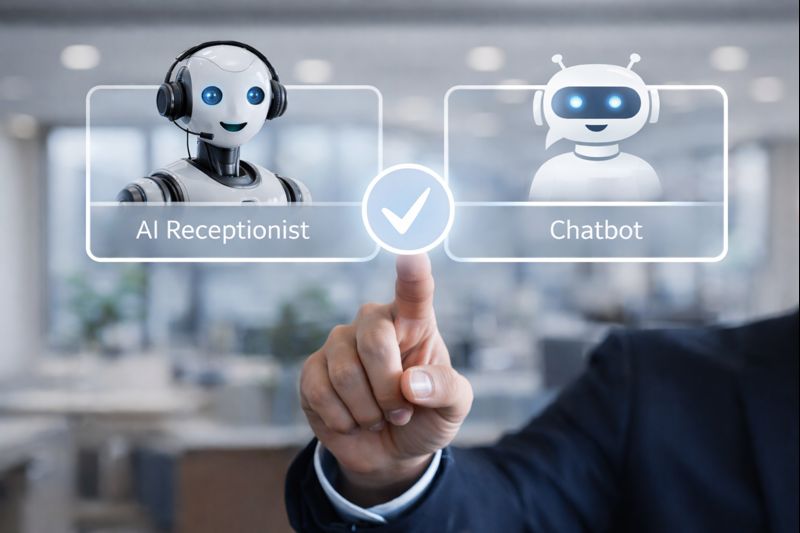
AI receptionist vs AI Chatbot
Not every business needs to start with voice automation. When businesses start exploring automated communication options, AI chatbots are often the first tool they consider. They are familiar, easy to deploy, and effective for handling website enquiries
When comparing the two AI options, the right choice depends on how customers prefer to contact you and where enquiries typically come from.
| Feature | AI receptionist | Chatbot |
| Primary channel | Phone calls and voice-based enquiries | Website and text-based enquiries |
| How customers interact | Speak naturally over the phone | Type questions or select prompts |
| Best use cases | Handling high-value calls, after-hours calls, and missed call coverage | Answering common questions, capturing leads, and supporting website visitors |
| Speed of implementation | Requires call setup and training | Often quicker to deploy |
| Impact on teams | Reduces phone interruptions | Reduces repetitive written enquiries |
| Availability | 24/7 | 24/7 |
| When it works best | When calls are a key part of sales or service | When most enquiries start online |
| Combined use | Complements chatbots using the same knowledge base | Complements AI receptionists for consistent answers |
Many businesses use both. A chatbot supports online enquiries, while an AI receptionist manages phone calls.
When both systems use the same approved knowledge, customers receive consistent information no matter how they choose to get in touch.
What to expect from an AI Receptionist
Understanding what an AI receptionist can and cannot do is essential, as these systems work best when expectations are clear from the start.
An AI receptionist can:
- Answer calls 24/7
- Provide consistent, approved business information
- Route calls to the right person or team
- Capture leads and enquiry details
- Support appointment requests, depending on setup
An AI receptionist cannot:
- Replace human judgment
- Handle sensitive or complex situations on its own
- Guess answers when information is missing
A well-designed system is intentionally limited. It knows when to respond and when to escalate. This protects both the caller and your business.
For small businesses, this often means fewer missed opportunities and more predictable call management without the cost of additional phone staff.
Common fears business owners have about AI receptionists
Many business owners worry about AI giving the wrong answers or damaging their brand. These concerns are understandable.
Most negative experiences come from poorly implemented systems. You are likely to encounter issues when the AI is trained on incomplete information, allowed to improvise, or left without clear escalation rules.
When an AI receptionist is implemented properly, these risks are greatly reduced. Approved knowledge is used. Boundaries are defined.
Calls are escalated when needed. The system supports your business rather than speaking on its behalf without control.
Learn more about how AI receptionists handle mistakes.
Why knowledge matters more than the voice
Many AI receptionist tools focus heavily on how realistic the voice sounds. While voice quality is important, it is not the most critical factor.
The quality of the information behind the voice matters far more.
If an AI receptionist does not understand your services, policies, or processes, it cannot deliver accurate answers. A friendly voice giving incorrect information still creates frustration and lost trust.
At AI Format, our AI voice agents are built around governed business knowledge. The system is designed not to guess.
If it cannot answer confidently, it escalates. This approach is what makes AI receptionists safe, reliable, and useful long-term.
Thinking about improving how your calls are handled?
An AI receptionist can reduce missed calls, improve customer experience, and support your team, but only when it is trained and implemented properly.
Many low-cost, do-it-yourself AI voice agent tools leave businesses to configure everything themselves. This is often where problems start, especially with voice agents that rely heavily on accurate, well-structured information.
Training an AI receptionist takes time, clarity, and a solid understanding of your business.
If your website content is incomplete, outdated, or inconsistent, even small changes can become frustrating and hard to manage.
That is why having the right partner matters.
If you are considering an AI receptionist or want to understand how AI voice agents could work for your business, call us today on 07 3532 6522 or submit an enquiry to speak with AI Format.
We will help you assess whether this is the right step and design a solution that fits your business properly.
About the Author

Declan Reynolds is the Founder and Director of AI Format and a digital marketing specialist with over 28 years of experience in SEO, web design, and AI-driven marketing. He works with established businesses across Australia to improve how they are found, understood, and recommended — by both search engines and AI platforms.
Learn more about Declan

Declan Reynolds
Articles: 115You may also like
Running for...
19 Yrs
We've lasted through industry change and now we embrace AI to last the next 19 years.
Boutique AI Agency...
7 Experts
We're a boutique agency using focused on a limited number of clients to get big results.
Long Relationships...
10+ Yrs
We have clients that have been using our SEO services for 10 years... TEN.
Search Specialists...
15 Yrs
We started as web developers but switched to focus on Search 15 years ago.
Certified
In AI
We've invested heavily in training staff in AI so you feel confident we're doing it right.